Portable light towers resolve the critical problem of inadequate visibility during overnight concrete pours, emergency storm repairs, and community gatherings when daylight runs out. Standard units feature a vertical…
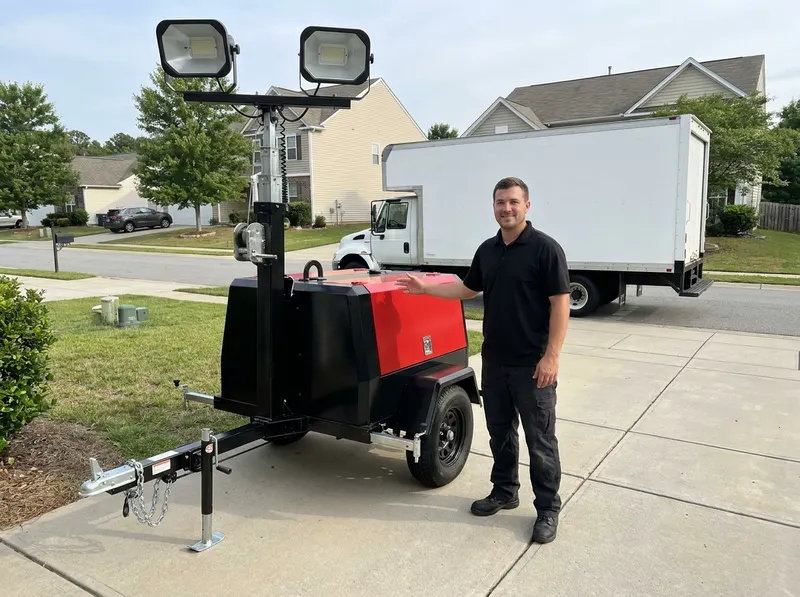
Portable light towers resolve the critical problem of inadequate visibility during overnight concrete pours, emergency storm repairs, and community gatherings when daylight runs out. Standard units feature a vertical or horizontal mast that extends up to 30 feet into the air, supported by four independent leveling outriggers rated for sustained winds up to 50 miles per hour. A 4-lamp LED setup draws power from a compact 3-cylinder liquid-cooled diesel engine, holding roughly 30 to 50 gallons of fuel to deliver up to 60 to 100 continuous run hours between refills. A light tower is strictly temporary jobsite illumination, not an auxiliary high-output electric utility distribution grid; while units feature auxiliary 120-volt or 240-volt convenience outlets, running heavy power tools simultaneously diminishes lighting output.
Project managers selecting lighting equipment in York County balance run time against transport footprint. In constrained residential spaces around Oakwood Acres or the Riverwalk development along Terrace Way, compact vertical-mast units fit onto packed driveways or side lots without blocking passing delivery traffic. For broader civil construction along the Rawlinson Road area or open commercial staging near the Hickory Grove corridor, wide-track horizontal units offer extended throw distances across 5 to 7 acres of unlit ground. If a project requires continuous work across an active right-of-way near India Hook or Newport, LED fixtures provide instant-on capability without the 10-to-15-minute ballast warm-up cycle standard on older metal halide systems.
Dispatch and deployment follow a straightforward three-step protocol. First, confirm your ground surface stability, noting that soft clay requires ground cribbing or timber pads beneath the leveling jacks. Second, the towable unit arrives via standard 2-inch ball hitch or pintle hook, maneuvers into the marked position, and levels out before mast elevation. Third, the operator starts the diesel power plant, activates individual circuit breakers for each lamp, and angles the individual lamp heads to eliminate high-contrast glare zones on working crews.
Every job gets a firm, written price after a free on-site visit.
Tell us about your light towers job in Rock Hill and we'll send a clear, written quote, usually the same day.
 JunkAway Dumpster Rental